How to Draw Phase Plane Plot
Show Mobile Notice Show All NotesHide All Notes
Mobile Notice
Yous appear to exist on a device with a "narrow" screen width (i.e. you lot are probably on a mobile phone). Due to the nature of the mathematics on this site it is best views in landscape fashion. If your device is non in landscape mode many of the equations will run off the side of your device (should be able to roll to see them) and some of the carte du jour items will be cut off due to the narrow screen width.
Section 5-6 : Phase Airplane
Before proceeding with actually solving systems of differential equations there's one topic that we need to take a look at. This is a topic that's not ever taught in a differential equations class but in case you're in a form where it is taught we should comprehend it so that yous are prepared for it.
Let's start with a general homogeneous system,
\[\begin{equation}\vec 10' = A\vec 10\label{eq:eq1}\end{equation}\]
Notice that
\[\vec x = \vec 0\]
is a solution to the organisation of differential equations. What we'd similar to ask is, exercise the other solutions to the system approach this solution equally \(t\) increases or practise they move away from this solution? Nosotros did something similar to this when we classified equilibrium solutions in a previous section. In fact, what nosotros're doing here is only an extension of this thought to systems of differential equations.
The solution \(\vec ten = \vec 0\) is called an equilibrium solution for the system. As with the unmarried differential equations case, equilibrium solutions are those solutions for which
\[A\vec x = \vec 0\]
Nosotros are going to presume that \(A\) is a nonsingular matrix and hence will take but ane solution,
\[\vec x = \vec 0\]
so we will have merely one equilibrium solution.
Back in the single differential equation instance recall that nosotros started by choosing values of \(y\) and plugging these into the function \(f(y)\) to make up one's mind values of \(y'\). We then used these values to sketch tangents to the solution at that particular value of \(y\). From this nosotros could sketch in some solutions and use this information to classify the equilibrium solutions.
We are going to do something similar here, but information technology will exist slightly different likewise. Get-go, we are going to restrict ourselves downwards to the \(2 \times 2\) case. So, we'll be looking at systems of the class,
\[\begin{array}{*{twenty}{c}}\begin{align*}{{x'}_1} & = a{x_1} + b{x_2}\\ {{x'}_2} & = c{x_1} + d{x_2}\end{align*}&{\hspace{0.25in} \Rightarrow \hspace{0.25in}\hspace{0.25in}\vec 10' = \left( {\begin{array}{*{20}{c}}a&b\\c&d\end{array}} \right)\vec ten}\terminate{array}\]
Solutions to this arrangement will exist of the course,
\[\vec x = \left( {\brainstorm{array}{*{xx}{c}}{{x_1}\left( t \right)}\\{{x_2}\left( t \right)}\stop{array}} \right)\]
and our single equilibrium solution volition exist,
\[\vec ten = \left( {\brainstorm{assortment}{*{20}{c}}0\\0\end{array}} \correct)\]
In the single differential equation example we were able to sketch the solution, \(y(t)\) in the y-t plane and see bodily solutions. Even so, this would somewhat difficult in this instance since our solutions are really vectors. What we're going to do here is think of the solutions to the organisation as points in the \({x_1}\,{x_2}\) plane and plot these points. Our equilibrium solution will stand for to the origin of \({x_1}\,{x_2}\). plane and the \({x_1}\,{x_2}\) aeroplane is called the phase plane.
To sketch a solution in the phase plane we can pick values of \(t\) and plug these into the solution. This gives us a point in the \({x_1}\,{x_2}\) or phase airplane that we can plot. Doing this for many values of \(t\) volition so requite united states a sketch of what the solution will be doing in the phase aeroplane. A sketch of a particular solution in the phase plane is chosen the trajectory of the solution. In one case we have the trajectory of a solution sketched nosotros tin then enquire whether or not the solution volition arroyo the equilibrium solution every bit \(t\) increases.
We would similar to exist able to sketch trajectories without actually having solutions in hand. There are a couple of means to practise this. Nosotros'll wait at one of those here and we'll look at the other in the next couple of sections.
1 way to get a sketch of trajectories is to do something similar to what we did the start fourth dimension we looked at equilibrium solutions. We can cull values of \(\vec x\) (notation that these will be points in the phase airplane) and compute \(A\vec x\). This will requite a vector that represents \(\vec x'\)at that item solution. As with the single differential equation case this vector will exist tangent to the trajectory at that betoken. We can sketch a bunch of the tangent vectors and then sketch in the trajectories.
This is a fairly piece of work intensive way of doing these and isn't the way to practise them in full general. However, it is a way to go trajectories without doing any solution work. All we demand is the organization of differential equations. Allow'due south take a quick wait at an example.
Instance i Sketch some trajectories for the system, \[\brainstorm{array}{*{20}{c}}\brainstorm{align*}{{ten'}_1} & = {x_1} + two{x_2}\\ {{x'}_2} & = 3{x_1} + 2{x_2}\end{align*}&{\hspace{0.25in} \Rightarrow \hspace{0.25in}\vec x' = \left( {\begin{array}{*{twenty}{c}}ane&ii\\three&2\end{array}} \right)\vec 10}\cease{array}\]
Show Solution
So, what we need to practice is pick some points in the stage plane, plug them into the right side of the system. We'll practice this for a couple of points.
\[\begin{align*}\vec x & = \left( {\brainstorm{array}{*{20}{c}}{ - 1}\\1\end{assortment}} \correct) & \Rightarrow \hspace{0.25in}\vec x'& = \left( {\begin{array}{*{xx}{c}}1&2\\3&ii\end{assortment}} \correct)\left( {\begin{array}{*{twenty}{c}}{ - 1}\\1\end{assortment}} \right) = \left( {\begin{array}{*{20}{c}}1\\{ - 1}\finish{assortment}} \right)\\ \vec x & = \left( {\begin{array}{*{20}{c}}two\\0\cease{assortment}} \correct) & \Rightarrow \hspace{0.25in}\vec x' & = \left( {\brainstorm{array}{*{20}{c}}ane&two\\3&ii\terminate{assortment}} \correct)\left( {\begin{array}{*{xx}{c}}2\\0\end{array}} \right) = \left( {\begin{array}{*{xx}{c}}ii\\half-dozen\stop{array}} \right)\hspace{0.25in}\\ \vec x & = \left( {\begin{array}{*{20}{c}}{ - 3}\\{ - 2}\end{array}} \right) & \Rightarrow \hspace{0.25in}\vec x' & = \left( {\begin{array}{*{20}{c}}ane&2\\3&2\finish{array}} \right)\left( {\brainstorm{array}{*{20}{c}}{ - three}\\{ - 2}\finish{assortment}} \correct) = \left( {\begin{assortment}{*{20}{c}}{ - 7}\\{ - 13}\finish{array}} \right)\hspace{0.25in}\terminate{align*}\]
And so, what does this tell the states? Well at the point \(\left( { - one,i} \right)\) in the phase plane there will be a vector pointing in the direction \(\left\langle {1, - 1} \right\rangle \). At the point \(\left( {2,0} \correct)\) there volition be a vector pointing in the direction \(\left\langle {two,6} \right\rangle \). At the point \(\left( { - three, - two} \right)\) there will be a vector pointing in the direction \(\left\langle { - seven, - 13} \right\rangle \).
Doing this for a large number of points in the phase plane volition give the following sketch of vectors.
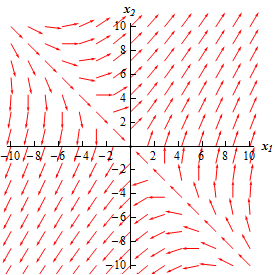
Now all nosotros demand to do is sketch in some trajectories. To do this all we need to practise is remember that the vectors in the sketch above are tangent to the trajectories. Also, the direction of the vectors give the direction of the trajectory as \(t\) increases so we can show the time dependence of the solution past adding in arrows to the trajectories.
Doing this gives the following sketch.
This sketch is called the phase portrait. Normally phase portraits just include the trajectories of the solutions and not whatsoever vectors. All of our phase portraits course this indicate on will just include the trajectories.
In this case it looks similar most of the solutions will starting time abroad from the equilibrium solution then as \(t\) starts to increase they move in towards the equilibrium solution and so eventually start moving away from the equilibrium solution again.
In that location seem to be 4 solutions that have slightly unlike behaviors. It looks like two of the solutions will start at (or almost at least) the equilibrium solution and then move direct abroad from information technology while 2 other solutions start away from the equilibrium solution and then move straight in towards the equilibrium solution.
In these kinds of cases we telephone call the equilibrium point a saddle point and we call the equilibrium point in this example unstable since all simply two of the solutions are moving away from it as \(t\) increases.
As we noted earlier this is not generally the way that we will sketch trajectories. All we really need to get the trajectories are the eigenvalues and eigenvectors of the matrix \(A\). Nosotros will see how to exercise this over the next couple of sections equally nosotros solve the systems.
Here are a few more phase portraits and then y'all can run across some more possible examples. We'll actually be generating several of these throughout the course of the next couple of sections.
Not all possible phase portraits have been shown here. These are here to show you some of the possibilities. Make sure to notice that several kinds tin can be either asymptotically stable or unstable depending upon the direction of the arrows.
Notice the difference between stable and asymptotically stable. In an asymptotically stable node or spiral all the trajectories will motion in towards the equilibrium signal every bit t increases, whereas a center (which is always stable) trajectory will just move effectually the equilibrium point just never actually move in towards it.
Source: https://tutorial.math.lamar.edu/classes/de/phaseplane.aspx
0 Response to "How to Draw Phase Plane Plot"
Postar um comentário